
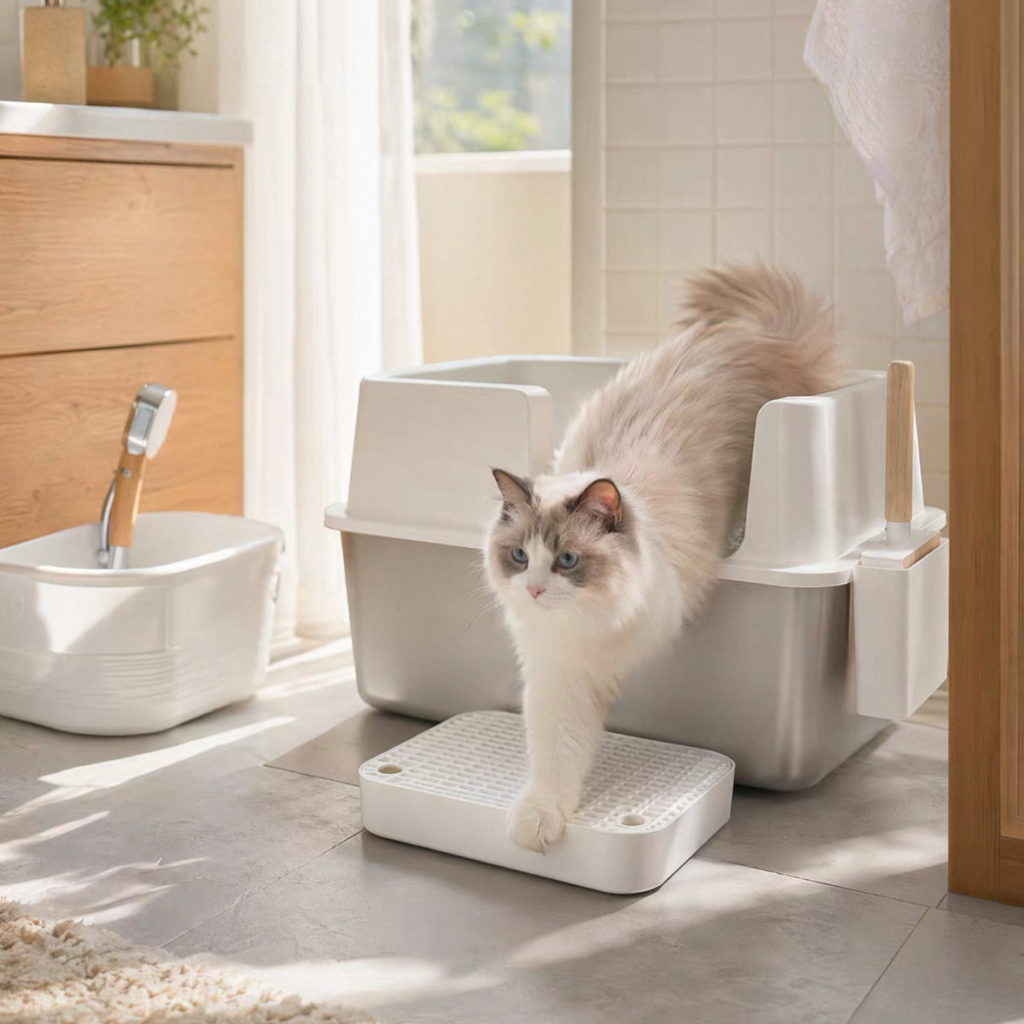
Ordering a stainless steel litter box for a private-label range involves more than choosing a shape and requesting a unit price. Importers, distributors and pet-product brands need a clear agreement on the product, packaging and approval process before committing to a bulk order.
This checklist helps purchasing teams turn an initial inquiry into a comparable specification. Use it when discussing a new model, reviewing a sample or preparing an OEM quotation request. It is a sourcing guide, not a claim that any particular model has passed a test or holds a certification.
1. Define the model and sales channel
Start with the product format your customers need: an open tray, a tray with a removable shield, or an enclosed design. Decide whether accessories such as a scoop, pedal or mat should be included in the retail pack or quoted separately.
Then describe the intended sales channel. A distributor supplying physical retailers may need different packaging information from a brand shipping individual units to online customers. Specify the destination country, planned pack configuration and expected ordering pattern so suppliers can quote against the same brief.
Record the configuration in writing
Create a configuration sheet with a model reference, photographs, included components and packaging requirements. Give the sheet a revision number. If you change a component after reviewing the sample, update the sheet rather than relying on a message buried in an email thread.
2. Request a model-specific specification
Ask for the material designation and finish of the tray, together with the materials used for any lid, shield, feet or accessories. A description of the main tray does not necessarily describe every component in the assembled product.
Request external dimensions, usable internal dimensions, entry height and product weight. Keep product dimensions separate from retail-pack and master-carton dimensions. Confirm which measurements are nominal and what tolerances the supplier proposes for acceptance.
Avoid turning broad words such as “premium,” “medical-grade” or “scratch-proof” into specifications. Ask what each claim means, what evidence supports it and which exact model that evidence covers. Do not repeat unsupported performance or health claims in your own product listing.
3. Agree how samples will be reviewed
Before a sample is dispatched, write down the checks that matter to your business. This makes feedback more specific and helps the supplier understand what must be resolved before production approval.
Practical sample-review questions
- Do the supplied dimensions and components match the quotation and specification sheet?
- Are exposed edges and corners finished to the agreed standard?
- Does the assembled product sit as expected on the surfaces you intend to evaluate?
- Can removable parts be fitted, removed and reinstalled as intended?
- Are the supplied cleaning and assembly instructions clear for the intended user?
- Does the retail packaging protect the sample during the agreed handling review?
Document observations with photographs and reference the configuration sheet. These checks help structure a discussion; they are not a substitute for professional testing where it is needed. Agree the scope, acceptance criteria and responsible party for any additional evaluation before placing the order.
4. Separate OEM requests from standard features
Prepare a list of requested changes: branding location, packaging artwork, color options, accessory bundles and instruction languages. Ask the supplier to identify which requests can be supported for the chosen model and which require additional development.
For each option, request written confirmation of the minimum order quantity, sample charges, tooling or setup costs, approval steps and estimated lead time. Keep these as quoted terms rather than assuming one model’s commercial conditions apply to the entire range.
If artwork or tooling is involved, agree how files will be approved, who will maintain the approved version and how future changes will be handled.
5. Check packaging and shipment information
Request the retail-pack dimensions, units per master carton, carton dimensions and gross weight. Confirm whether accessories are packed inside the tray or in a separate compartment. Ask for photographs of the proposed packing method before approving artwork around an assumed layout.
For shipment planning, obtain a current quotation with a named delivery location and a clearly stated allocation of freight-related costs. Confirm the packing configuration used for any quantity estimate. A product-size estimate alone is not enough to establish final shipment requirements.
6. Review documentation for the destination market
Tell the supplier where the product will be sold and ask which documents are available for the exact model and configuration. Check that any report supplied identifies the relevant product, materials or components rather than treating a general company document as product-specific evidence.
If the design includes a powered accessory, list it separately in the specification and request its documentation as well. Have a qualified adviser review destination-market obligations where needed. This checklist does not establish which legal requirements apply to a particular product.
7. Compare quotations on the same basis
Before comparing prices, check that each quote includes the same product configuration, accessories, packaging, artwork scope and approval requirements. Record exclusions beside the price so they remain visible during negotiation.
Clarify payment stages, the proposed production schedule, sample approval dependencies and the process for reporting discrepancies. Ask how replacements or other remedies would be agreed if delivered goods differ from the approved specification; do not assume a remedy that is not part of the contract.
Frequently asked questions
What should I include in an OEM inquiry?
Include the model or reference images, destination market, planned quantity, required dimensions, accessory bundle, branding requirements and packaging format. Identify requirements that are still open so they can be discussed before the quotation is finalized.
Can a stainless steel litter box be sold under a private label?
Private-label availability depends on the model and the supplier’s confirmed customization scope. Request written confirmation of branding options, artwork approval, order quantities and any additional charges for your project.
Is one sample enough to approve a bulk order?
A sample can help confirm the intended configuration, but it does not establish the consistency of a future production run. Agree a suitable production and inspection plan with the supplier before ordering.
Which details should be confirmed before paying a deposit?
Confirm the specification revision, approved sample reference, quantities, price basis, packaging, payment stages, delivery expectations and the agreed process for handling discrepancies. Resolve unclear terms before committing to the order.
Discuss your stainless steel litter box sourcing project
Review our product range to identify a starting point for your inquiry. Then contact our team with your destination market, planned quantity, preferred configuration and packaging requirements.
Ask for current specifications and a model-specific OEM quotation. Product options, commercial terms and delivery timing should be confirmed in writing for your order.

Written by
YounihaoContent team at Younihao Technology -- sharing industry insights on pet product manufacturing, OEM/ODM solutions, and global market trends.